



.svg)


Academy
How Currency Pairs Work in a Funded Forex Account

•
Sep 30th, 2026
•
9 min
read


AI - generated summary

Ask AI
TL;DR: A currency pair quotes one currency (the base) in units of another (the quote), so EUR/USD at 1.0850 means 1 euro costs 1.0850 US dollars, and buying the pair means you are long EUR and short USD. The seven majors (EUR/USD, USD/JPY, GBP/USD, USD/CHF, AUD/USD, USD/CAD, NZD/USD) carry the tightest spreads, minors or crosses (EUR/GBP, EUR/JPY, GBP/JPY) skip the USD, and exotics (USD/TRY, USD/ZAR) trade wide and thin. A pip is 0.0001 on most pairs and 0.01 on JPY pairs, worth about $10 per standard lot on EUR/USD and about $6.67 per lot on USD/JPY at 150.00. In a funded or evaluation account the quote only matters once you convert it to money at risk: lot size = risk per trade ÷ (stop in pips × pip value per lot), and that risk should be a fraction of the daily loss limit, because a breach closes the account instead of just costing a drawdown.
You are in MT5 with an evaluation account and a GBP/JPY setup. Before you click buy, you need three answers: what buying that pair means, how much one pip costs, and how many pips you can lose before the daily loss limit ends the account.
Most guides stop at the first question. In a funded account, the third one is the only one that can end the account.
What a Currency Pair Is and How the Quote Works
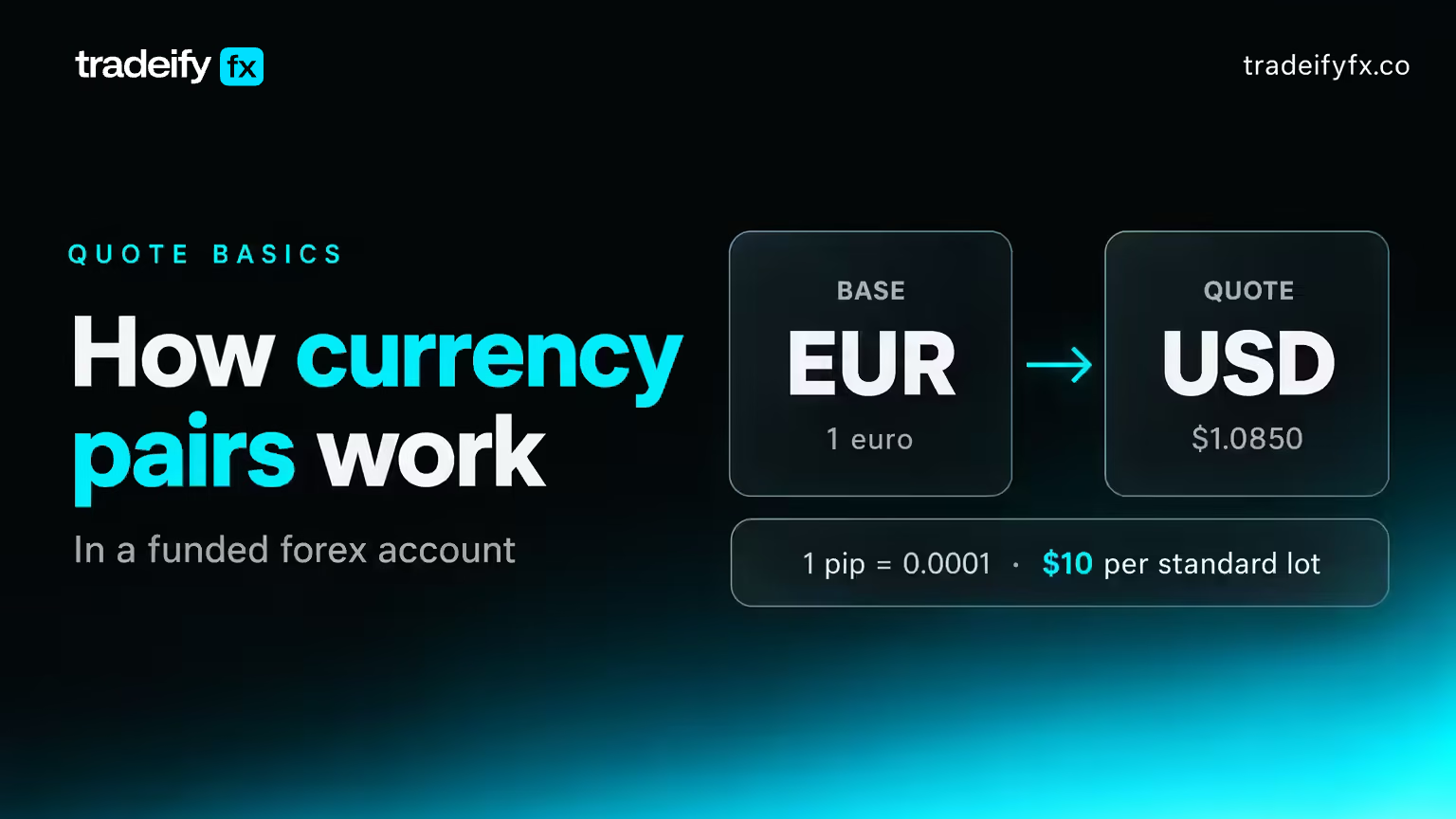
A currency pair is two currencies priced against each other. The first is the base currency, the second is the quote currency, and the number tells you how much of the quote currency buys one unit of the base.
Example: EUR/USD at 1.0850. One euro costs 1.0850 US dollars. At 1.0900 the euro strengthened against the dollar; at 1.0800 it weakened.
Buying EUR/USD means buying euros with dollars, so you want the number to rise. Selling is the reverse. Every position is long one currency and short the other.
Your MT5 quote window shows two prices for every pair:
- Bid, the price you sell at.
- Ask, the price you buy at.
- Spread, the gap between them, paid the moment you enter.
EUR/USD might show 1.08500 / 1.08508, a 0.8 pip spread. GBP/JPY might show 190.500 / 190.530, a 3 pip spread. Every pip of spread comes out of a daily loss budget you do not set.

Pips, Lots, and What One Currency Pair Tick Costs
A pip is the standard unit of movement: the fourth decimal (0.0001) on most pairs, the second decimal (0.01) on pairs quoted in Japanese yen. Position size is measured in lots. One standard lot is 100,000 units of the base currency, a mini lot is 0.1, a micro lot is 0.01.
Pip value depends on the pair:
- USD as the quote currency (EUR/USD, GBP/USD, AUD/USD): one pip on one standard lot is $10, fixed.
- USD as the base (USD/JPY, USD/CAD, USD/CHF): pip value in USD floats with the rate. USD/JPY at 150.00: 1,000 JPY ÷ 150 = about $6.67 per pip per lot.
- Crosses (EUR/GBP, GBP/JPY): pip value is fixed in the quote currency, then converted to your account currency. GBP/JPY at 190.00 is 1,000 JPY per pip per lot, about $6.67 if USD/JPY is 150.00.
MT5 shows the tick value in the symbol specification. A trader who assumes every pair is "$10 a pip" and trades GBP/JPY at 1.5 lots is sizing blind.
Majors, Minors, and Exotics in a Funded Forex Account
The group a pair belongs to tells you what the spread and the volatility are likely to do to your loss limit.
The seven major currency pairs
The majors all contain the US dollar and carry most of global forex volume:
- EUR/USD
- USD/JPY
- GBP/USD
- USD/CHF
- AUD/USD
- USD/CAD
- NZD/USD
Deep liquidity means tight spreads and price that moves in smaller steps, so the cost of being wrong stays close to what your stop says it is.
Minor and cross currency pairs
Minors, or crosses, do not include the USD: EUR/GBP, EUR/JPY, GBP/JPY, AUD/JPY, EUR/CHF.
A cross is priced from two USD legs. EUR/GBP is effectively EUR/USD divided by GBP/USD, so a UK data release moves it even when nothing happened in the eurozone.
Crosses have wider spreads and, for the yen crosses, larger ranges. GBP/JPY can cover 150 pips in a session where EUR/USD covers 60. Same lot size, more than twice the money at risk.
Exotic currency pairs
Exotics pair a major with an emerging-market currency: USD/TRY, USD/ZAR, USD/MXN. Spreads can run 20 to 100 pips or more, liquidity thins outside local hours, and gaps are common on political news.
A wide spread means the trade opens already down a share of your risk. A gap through your stop means the loss can exceed the plan. A daily loss limit forgives neither.
Liquidity, Sessions, and When Currency Pairs Move
Liquidity is how much volume sits at each price. High liquidity means tight spreads and orderly movement. Low liquidity means wider spreads and jumps. It changes across three overlapping sessions (winter GMT, with New York time in brackets; the GMT times move an hour earlier while the UK and US are on summer time):
- Tokyo, roughly 00:00 to 09:00 GMT (7pm to 4am New York). JPY, AUD, and NZD pairs are most active, ranges are usually smaller.
- London, roughly 08:00 to 17:00 GMT (3am to noon New York). The highest-volume session. EUR, GBP, and CHF pairs move most.
- New York, roughly 13:00 to 22:00 GMT (8am to 5pm New York). USD pairs move on US data. The London and New York overlap, 13:00 to 17:00 GMT (8am to noon New York), is typically the most liquid window of the day.
The failure mode is trading a pair outside its session. EUR/USD at 22:00 GMT has a wider spread, a thinner book, and more spikes that hit a stop and reverse. Spreads also widen around the 17:00 New York rollover, and holding a loser through it to "let it come back" is a common way to turn a controlled loss into a limit breach.

Turning a Currency Pair Quote Into Position Size Against the Daily Loss Limit
A retail trader who oversizes loses money. A funded trader who oversizes loses the account. So the quote has to become a money figure before the trade.
Lot size = risk per trade ÷ (stop in pips × pip value per 1.0 lot)
Worked example (use your own plan's figures from its Trading Rules). Imagine a $50,000 simulated balance with a 3% daily loss limit, $1,500. The trader caps any single trade at a fifth of that, $300.
- Setup: long EUR/USD at 1.0850, stop at 1.0825, a 25 pip stop.
- Pip value: $10 per standard lot.
- Lot size = $300 ÷ (25 × $10) = 1.2 lots.
Same trader, a GBP/JPY setup at 190.50 with a 60 pip stop and a pip value of about $6.67 per lot:
- Lot size = $300 ÷ (60 × $6.67) = 0.749, rounded down to 0.74 lots.
Same dollar risk, different lot size. Trading both at 1.2 lots would put $480 at risk on GBP/JPY, 60% more than planned, and three of those losses would sit at $1,440, within $60 of the limit before spread and slippage.
The per-trade number is a fraction of the daily limit because losing streaks are normal. Four losses in a row on a 40% win rate strategy is not unusual. It should not end an account.
Two rules that follow:
- Add the spread to the stop distance. A 25 pip stop with a 2 pip spread is a 27 pip risk.
- Reduce size on correlated pairs. Long EUR/USD and short USD/CHF is close to one trade taken twice.
Risks and Mistakes That End Funded Accounts on Currency Pairs
The mistakes are rarely about reading the quote wrong. They are about what happens after a loss.
- Oversizing to recover. After a $300 loss, the temptation is to size the next trade at 2.4 lots to get it back in one move. That trade risks $600, and one more loss at that size reaches the $1,500 limit.
- Switching to a faster pair. A trader who lost on EUR/USD moves to GBP/JPY because "it moves more." It does, in both directions.
- Ignoring leverage. Leverage is what makes 2.0 lots possible on a $50,000 simulated balance. It also means a 1% move against 2.0 lots of EUR/USD is about $2,170, more than the whole daily limit.
- Holding through news. A pair can move 50 pips in a second on a central bank surprise, and a stop is not a guarantee of fill price.
Each has the same fix. Decide the risk in money before you touch the lot field.
Currency Pair FAQs
What are the 7 major currency pairs?
EUR/USD, USD/JPY, GBP/USD, USD/CHF, AUD/USD, USD/CAD, and NZD/USD. Every major includes the US dollar, and together they carry the majority of daily forex volume.
What is the best currency pair to trade for beginners?
EUR/USD: the tightest spread of any pair, a fixed pip value of $10 per standard lot, and the deepest liquidity, so stops fill close to where they are placed. It is not easier to predict. Its costs and mechanics are easier to control.
Is $100 enough to start forex?
In a personal retail account, $100 allows only micro lots and leaves little room for a normal losing streak. That is one reason traders look at evaluation accounts, where a fee buys access to a larger simulated balance that comes with rules. Neither route removes the risk of loss.
What are the top 5 currency pairs to trade?
By volume, EUR/USD, USD/JPY, GBP/USD, AUD/USD, and USD/CAD. For clean sizing, start with EUR/USD and GBP/USD because of their fixed USD pip value.
How do cross currency pairs work?
A cross is a pair without the USD, such as EUR/GBP or GBP/JPY. Its price comes from the two USD legs, so it moves on news from either currency, and its wider spread and larger range belong in the position size calculation.
Next Step for Trading Currency Pairs in a Funded Account
Open MT5, pick one major pair, and do the sizing calculation by hand before the next trade: risk in money, stop in pips, pip value from the symbol specification, then the lot size. Write it down for ten trades. If the lot field ever shows a bigger number than the one you wrote, the account is at risk, and it has nothing to do with the chart.
Our MT5 evaluation accounts at Tradeify FX use a simulated balance, so you are not depositing or trading your own money, and rewards are calculated from simulated performance under our Trading Rules. Our Classic and Direct plans carry a 3% daily loss limit, the figure used in the worked example above. The Daily 1-Step plan has no daily loss limit, so a Daily trader sizes against its 5% trailing max loss instead. The sizing method above is how you keep a position inside those rules on any pair.
Trading leveraged CFDs carries a high level of risk and is not suitable for everyone. Evaluation and funded accounts are simulated, and simulated results are not indicative of live-market results. Nothing here guarantees passing an evaluation, receiving funding, making a profit, or receiving a payout.
Recommended


Keep Reading
See all
Academy
Sep 30th, 2026
Pips, Pipettes, and Lot Sizes Explained for Funded Forex Accounts

Academy
Sep 30th, 2026
How to Calculate Forex P&L on a Funded Account
Academy
Sep 30th, 2026
