



.svg)


Academy
Pips, Pipettes, and Lot Sizes Explained for Funded Forex Accounts

•
Sep 30th, 2026
•
11 min
read


AI - generated summary

Ask AI
TL;DR: A pip is the fourth decimal on most pairs (0.0001 on EUR/USD) and the second decimal on JPY pairs (0.01 on USD/JPY); a pipette is one tenth of a pip, the fifth or third decimal MT5 shows. Pip value per lot = (one pip / current price) x contract size, which gives $10 per pip on a standard lot (100,000 units), $1 on a mini lot (0.10, 10,000 units), and $0.10 on a micro lot (0.01, 1,000 units) for EUR/USD, and about $6.67 per standard lot on USD/JPY at 150.00. The number that keeps a funded account alive is the reverse calculation: lots = dollar risk / (stop in pips x pip value per lot), so a 25 pip stop risking $500 on EUR/USD is 2.0 lots, and a 3% daily loss limit on a 100,000 simulated account ($3,000) leaves room for five of those losses (a sixth reaches the limit), not one oversized trade.
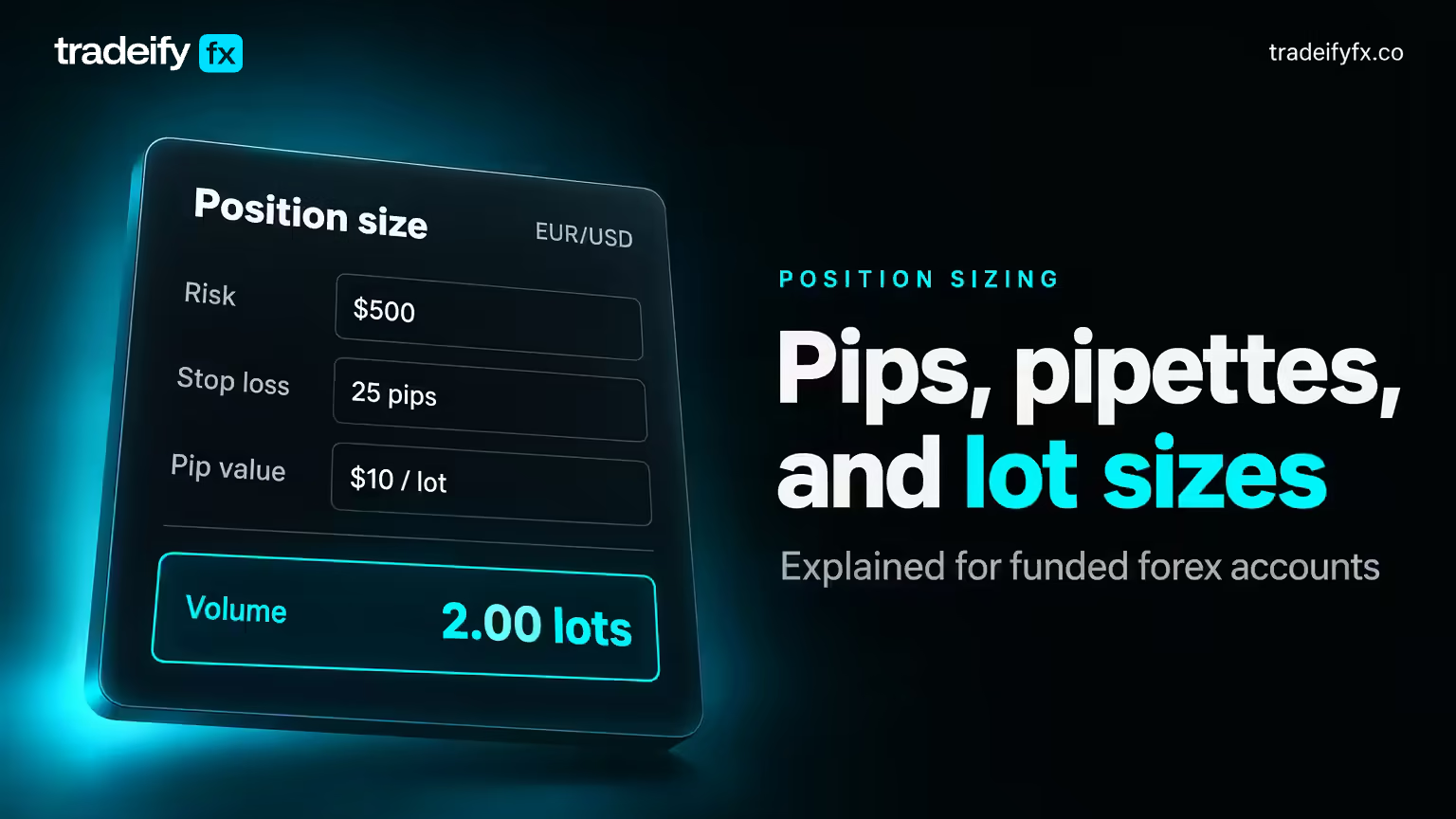
You are about to click buy on EUR/USD. The setup is fine. The stop is 25 pips below entry. The only question left is the volume field in the MT5 order ticket, and that field decides whether a normal losing trade costs you $50, $250, or the whole evaluation.
Retail guides explain pips and lots so you can read a quote. On a funded or evaluation account you need them for a different reason: every stop distance, multiplied by every lot size, has to fit inside a daily loss limit and a maximum drawdown that can close the account. A sizing mistake does not just lose money. It can end the account.
What a pip measures
A pip (price interest point) is the standard unit of price movement in forex. On most pairs it is the fourth decimal place.
- EUR/USD moves from 1.0850 to 1.0851. That is one pip.
- GBP/USD moves from 1.2700 to 1.2650. That is 50 pips.
- USD/CAD moves from 1.3600 to 1.3720. That is 120 pips.
Traders quote spreads, stops, targets, and daily ranges in pips because it removes the account from the conversation. A 30 pip stop is a 30 pip stop whether the trade is 0.01 lots or 5 lots.
Where pips cause trouble is the moment they get treated as money. A 30 pip loss is not a fixed cost. It is 30 times the pip value of whatever size you chose.

The pipette and the fifth decimal on MT5
MT5 quotes most pairs to five decimals. That fifth digit is the pipette, one tenth of a pip.
- EUR/USD at 1.08503 is 1.0850 and 3 pipettes.
- A move from 1.08503 to 1.08517 is 1.4 pips, or 14 pipettes.
Pipettes are why a "0.8 pip" spread makes sense. They are also where new prop-firm traders get caught, because MT5 reports many values in points, and a point is a pipette. A stop of "300 points" in an order ticket or expert advisor is 30 pips. Enter 30 points when you meant 30 pips and you have a 3 pip stop that the spread alone can hit. Check whether the field says pips or points before you trust it.
The JPY exception for counting pips
Yen pairs are quoted with two decimals, so the pip is the second decimal (0.01) and the pipette is the third.
- USD/JPY moves from 150.00 to 150.25. That is 25 pips.
- GBP/JPY at 190.123 is 190.12 and 3 pipettes.
This changes the pip value, not just the counting. A JPY pip is 0.01 of a yen rather than 0.0001 of a dollar, so its dollar value depends on the USD/JPY rate and is usually lower than on EUR/USD. A 30 pip stop on GBP/JPY and a 30 pip stop on EUR/USD are different dollar amounts at the same lot size, which is exactly the kind of detail that produces an accidental limit breach.
Lot sizes from standard to micro
A lot is the contract size of a position, measured in units of the base currency.
- Standard lot: 1.00 in MT5, 100,000 units.
- Mini lot: 0.10 in MT5, 10,000 units.
- Micro lot: 0.01 in MT5, 1,000 units.
- Nano lot: 0.001, 100 units. Most MT5 CFD accounts do not offer it, so treat 0.01 as the practical minimum.
The MT5 volume field is always in standard lots, usually in 0.01 steps. Typing 0.25 means 25,000 units. A common misread: "0.01 lot" is not 1% of anything. It is a fixed 1,000 units of exposure on a 10,000 account and on a 200,000 account alike.
Calculating pip value per lot size
For pairs where USD is the quote currency (EUR/USD, GBP/USD) on a USD account:
Pip value = one pip x contract size = 0.0001 x 100,000 = $10 per standard lot, at any price.
For pairs where USD is the base currency (USD/JPY, USD/CAD), divide by the current price:
Pip value = (one pip / current price) x contract size
For a cross like GBP/JPY, work out the value in the quote currency (JPY) and convert to USD at the USD/JPY rate. In practice you read the number from the MT5 contract specification or a position size calculator, but you should be able to sanity-check it by hand.
Pip value table for common pairs and lot sizes
Values are approximate, for a USD account, at the example prices shown. Recalculate at the live rate before sizing.
| Instrument | Example price | One pip | Standard lot (1.00) | Mini lot (0.10) | Micro lot (0.01) |
|---|---|---|---|---|---|
| EUR/USD | 1.0850 | 0.0001 | $10.00 | $1.00 | $0.10 |
| GBP/USD | 1.2700 | 0.0001 | $10.00 | $1.00 | $0.10 |
| AUD/USD | 0.6500 | 0.0001 | $10.00 | $1.00 | $0.10 |
| USD/JPY | 150.00 | 0.01 | $6.67 | $0.67 | $0.07 |
| USD/CAD | 1.3600 | 0.0001 | $7.35 | $0.74 | $0.07 |
| GBP/JPY | 190.00 (USD/JPY 150.00) | 0.01 | $6.67 | $0.67 | $0.07 |
| XAU/USD (gold, 100 oz per lot) | 2,400.00 | 0.01 (broker-defined) | $1.00 | $0.10 | $0.01 |
GBP/JPY and USD/JPY share a USD pip value because both have JPY as the quote currency. Gold has no universal pip: some brokers define it as a $0.01 move (as above), others as $0.10, which makes the per-lot values ten times larger. The reliable way to think about gold is dollars per ounce. One standard lot is 100 ounces, so a $1.00 move is $100 on 1.00 lot and $1 on 0.01 lot.
If your account is in EUR or GBP, convert the USD pip value at the current rate. A $10 pip on EUR/USD is about EUR 9.22 at 1.0850. MT5 does this in the profit column, but it matters when you size by hand.
Turning pips into profit and loss
Profit or loss = pips x pip value x lots.
Example: a trader buys 0.50 lots of EUR/USD at 1.0850 and closes at 1.0890. That is 40 pips at $5 per pip (0.50 x $10), or $200 before spread and commission.
The losing version is the one that matters on a funded account. Same 0.50 lots, stopped 25 pips below entry: 25 x $5 = $125. Add a 1 pip spread paid on entry and the realised loss is closer to $130.
Spread scales with size too. On 0.01 lot it rounds to cents. On 2.00 lots a 1 pip spread is $20 per trade, and a 5 pip spread at rollover or around a data release is $100 before price has moved. That is why a stop that looked safe on paper can fill worse than planned.

Sizing a lot so a normal stop cannot breach the daily loss limit
Flip the pip value formula around:
Lots = dollar risk per trade / (stop in pips x pip value per standard lot)
Work from the rule downward, not from the setup upward. Imagine a 100,000 simulated evaluation account with a 3% daily loss limit ($3,000) and a 10% static maximum drawdown ($10,000). Plans differ, and some have no daily loss limit at all, so take the real numbers from your own account's Trading Rules.
- Decide how many losing trades in a row the day should absorb. Four is a reasonable floor, which keeps per-trade risk under $750 (0.75%) so the fourth loss still lands short of the limit.
- Most funded traders use less, 0.25% to 0.5%, so a bad day uses a fraction of the limit. Take 0.5%: $500 per trade.
- EUR/USD with a 25 pip stop: $500 / (25 x $10) = 2.00 lots.
- GBP/JPY with a 40 pip stop: $500 / (40 x $6.67) = 1.874 lots, rounded down to 1.87.
- Gold with a $6.00 stop: $500 / ($6.00 x $100 per lot) = 0.833 lots, rounded down to 0.83.
The dollar risk stayed at $500 every time. The lot size moved every time because the stop distance and pip value moved. Fixed lots with variable stops produce variable risk, and variable risk is how a daily limit gets breached by a trade that looked normal.
Now the failure mode. A trader takes two $500 losses before London opens and is down $1,000. The temptation is to size the third trade at 4.00 lots to get it back in one. With a 25 pip stop that trade risks $1,000. It loses, the day is at $2,000, and one more oversized attempt reaches the $3,000 limit. Three losses at planned size would have cost $1,500 and left the rest of the week intact.
The formula also checks the setup itself. If the chart demands an 80 pip stop and the result is 0.06 lots, fine. If you find yourself tightening the stop to 10 pips so you can trade 5.00 lots, the stop has stopped being a technical decision and become a sizing excuse.
Two rules the formula does not enforce on its own:
- Treat floating loss as real. Most daily limits count open positions, so three trades each risking $500 is $1,500 of exposure right now.
- Round lots down, never up. The few dollars you give up are cheaper than the few dollars past the line.
FAQ on pips, pipettes, and lot sizes
How do I convert lot sizes to pips?
You cannot convert one into the other, because a lot is position size and a pip is price movement. What you can convert is pips to dollars at a given lot size (pips x pip value x lots), or a dollar risk and stop distance into a lot size (dollars / (pips x pip value)). If someone asks "how many pips is 0.5 lots," the honest answer is "$5 per pip on EUR/USD."
How many pips are in 0.01 lot?
A 0.01 lot has no pip count; it is 1,000 units of the base currency. What it has is a pip value: about $0.10 per pip on EUR/USD, GBP/USD, and AUD/USD, about $0.07 on USD/JPY at 150.00, and $0.01 to $0.10 per broker-defined pip on gold. A 100 pip move on 0.01 lot of EUR/USD is $10.
How much is 50 pips worth?
It depends entirely on lot size. On EUR/USD, 50 pips is $5 on a micro lot (0.01), $50 on a mini lot (0.10), $500 on a standard lot (1.00), and $1,000 on 2.00 lots. On USD/JPY at 150.00 the same 50 pips is about $333 on a standard lot.
How much is 100 pips worth?
Double the numbers above: $10 on 0.01 lot of EUR/USD, $100 on 0.10, $1,000 on 1.00. On a 100,000 account with a 3% daily limit, a 100 pip stop at 1.00 lot is a third of the day's allowance in one trade, which is why wide-stop trades are usually sized in mini lots.
What lot size should I use on a 100k account?
Start from the risk per trade, not the account size. At 0.5% risk ($500) and a 25 pip stop on EUR/USD, 2.00 lots. Same risk with a 50 pip stop, 1.00 lot. At 0.25% risk and a 40 pip stop, 0.625 lots, rounded down to 0.62. A fixed answer like "2 lots on a 100k" is wrong whenever the stop distance changes, and it changes every trade.
How much is 1,000 pips in a 0.01 lot of gold worth?
It depends on the broker's gold pip. If one pip is a $0.01 move, 1,000 pips is a $10.00 move, worth $10 on 0.01 lot (1 ounce). If one pip is a $0.10 move, 1,000 pips is a $100 move, worth $100 on 0.01 lot. Check the MT5 contract specification and think in dollars per ounce: 0.01 lot of gold gains or loses $1 for every $1.00 the metal moves.
Put pip value and lot size to work before the next trade
Before your next entry, do the calculation in this order:
- Write down the daily loss limit and maximum drawdown from your account rules in dollars. If your plan has no daily loss limit, size against the maximum drawdown instead.
- Choose a fixed per-trade risk that leaves room for at least four losses in a day.
- Measure the stop in pips from the chart, not from the size you want to trade.
- Look up the pip value for that pair at the current price.
- Divide, round down, and enter that number in the volume field.
If four consecutive stops at that size would pass the daily limit, the size is too large, regardless of how good the setup looks.
If you are preparing for a funded forex account, our MT5 evaluation accounts use simulated balances under our Trading Rules, so the same pip and lot math applies from the first trade: your stop distance, your lot size, and your daily limit have to agree before you click buy. Our Classic and Direct plans carry a 3% daily loss limit and the Daily 1-Step plan has none; maximum loss is 10% static on Classic, 5% trailing on Daily, and 6% trailing on Direct. Trading leveraged CFDs carries a high level of risk and is not suitable for everyone. Evaluation and funded accounts are simulated, results are not indicative of live-market results, and nothing here guarantees passing, funding, profit, or payout.
Recommended


Keep Reading
See all
Academy
Sep 30th, 2026
How to Calculate Forex P&L on a Funded Account
Academy
Sep 30th, 2026
Forex Spreads and Commissions Explained for Funded Account Traders
Academy
Sep 30th, 2026
