



.svg)


Academy
What Is Swap in Forex and Why Funded Traders Pay It

•
Sep 30th, 2026
•
10 min
read


AI - generated summary

Ask AI
TL;DR: Swap in forex (also called rollover or overnight funding) is the interest credited or debited when you hold a CFD position past the 5pm New York rollover, and it comes from the interest-rate differential between the two currencies in the pair plus the broker's markup. Each pair has a separate swap long and swap short figure, shown in the MT5 symbol specification in points, so a position can earn positive swap or pay negative swap depending on direction. Wednesday rollover charges 3 days at once to cover the weekend, so a 1-lot EUR/USD long at an example -7.5 points per night held Monday to Friday pays 7 swap days, about $52.50 on a USD account. In a funded or evaluation account, swap posts against the same daily loss limit and max drawdown as your trades, which is why holding a loser through rollover to "let it come back" quietly widens the hole. Swap-free (Islamic) accounts replace the interest with a fixed administration fee, and the carry trade is the one strategy that treats positive swap as the goal rather than a cost.
You are long EUR/USD at 1.0850, down 30 pips at 4:55pm New York time, and the trade has not hit your stop. Closing now locks in a loss you can see. Holding adds a loss you cannot see yet: swap.
Most explanations of swap are written for a retail trader risking their own deposit. In a funded account, every cost that touches equity also touches your daily loss limit and max drawdown, and a rule breach ends the account. Swap belongs on that list.
Swap, Rollover, and Overnight Funding Mean the Same Thing
Three names, one charge:
- Swap is the MT5 and broker-statement term. It appears as its own column in your account history.
- Rollover describes the mechanic. Your spot position is settled and re-opened for the next value date, and the interest difference between the two dates is the swap.
- Overnight funding is the CFD-industry wording. Same number, viewed as the cost of borrowing one currency to hold the other.
Short answer: swap is the interest you pay or receive for holding a leveraged currency position from one trading day into the next. Flat before rollover, you never see it. Hold, and it posts every night.

Where the Swap in Forex Comes From
Every currency pair is a loan in one currency funding a deposit in the other. Long EUR/USD means you hold euros (earning the eurozone rate) and owe dollars (costing the US rate).
The raw swap is the difference between those two rates, scaled to your position size and one day of interest. Two things move it away from that clean number:
- Broker markup. The liquidity provider quotes a tom-next rate and the broker adds a spread on both sides. That is why swap long and swap short rarely mirror each other, and why one side is often negative even when the rate differential is near zero.
- Funding market conditions. Interbank swap rates move daily, so the figure on your platform is updated regularly.
Long Swap and Short Swap on the Same Pair
Each symbol carries two swap figures. Swap long applies to buy positions; swap short applies to sells. On AUD/JPY, where the Australian rate has sat above the Japanese rate for years, a long can receive swap while a short pays it.
Where the two rates are close, both sides may be negative after markup. Before a multi-day hold, know which side of the swap you are on.
Positive Swap and Negative Swap in Your Account
Positive swap credits your account at rollover. Negative swap debits it. On MT5 the running total sits in the Swap column of the open position and moves your floating P&L directly.
Most funded programs measure the daily loss limit against equity, which includes floating P&L. Negative swap accumulates inside that number. A trade sitting at your personal daily stop on Tuesday morning is past it on Wednesday morning without price moving.
Positive swap is real but small next to price risk. A 1-lot position earning $3 a night can lose $100 on a 10-pip move. It is an offset to holding cost, not a reason to hold.
Swap Rollover Happens at 5pm New York
Swap is applied at 5:00pm New York time, the end of the forex trading day. That is 21:00 or 22:00 UTC depending on US daylight saving, and your MT5 server clock may show it as a different hour.
Two things happen at that moment:
- Any position open at the tick of rollover is charged or credited, even if it was opened one minute earlier.
- Spreads often widen for a few minutes as liquidity providers reprice for the new value date.
The second point catches tight stops. A position that survives rollover can still be stopped out by the widening, and in a funded account that counts like any other loss.
Triple Swap Wednesday Explained
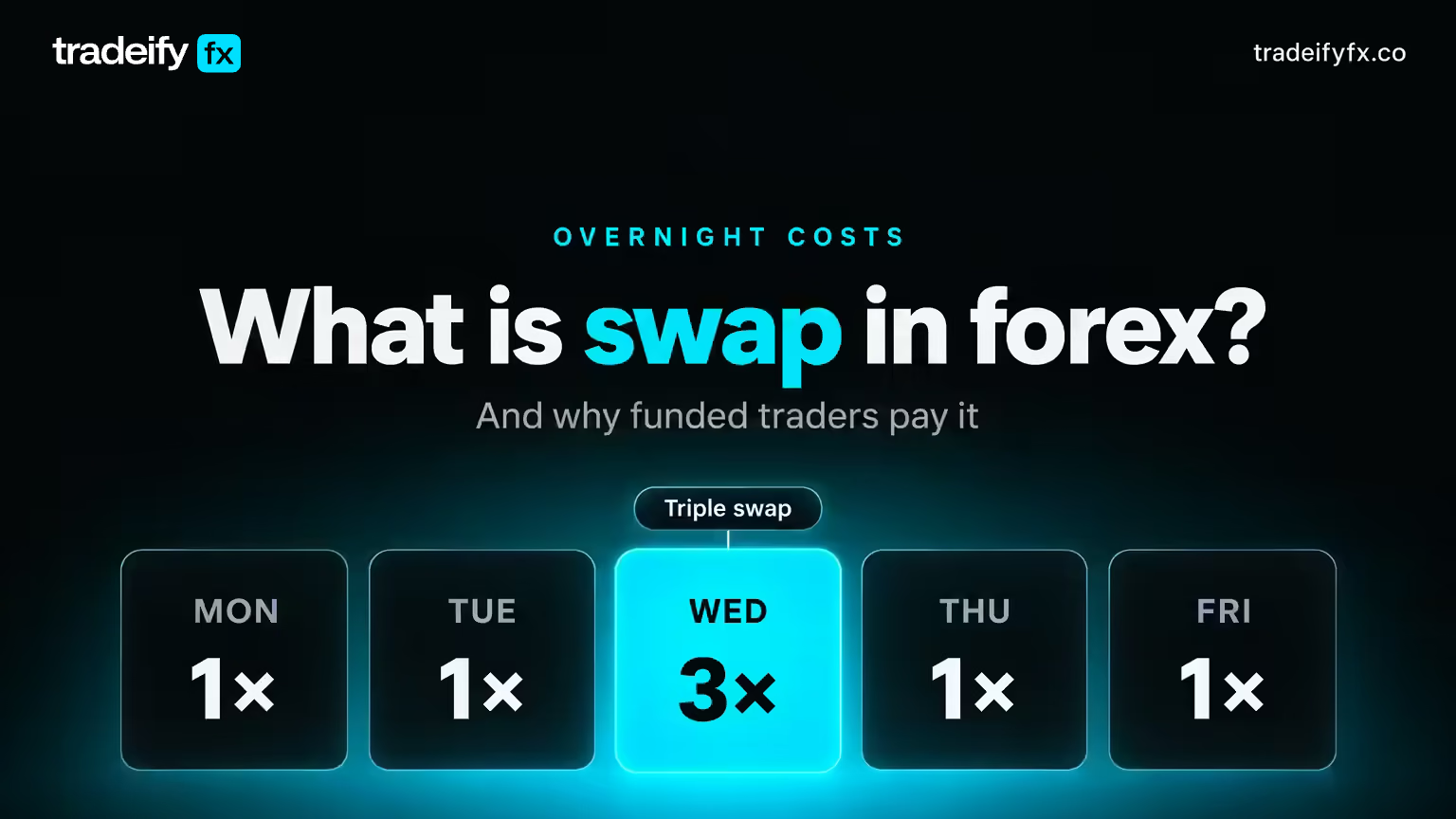
Spot forex settles T+2. A position rolled Wednesday night gets a Friday value date. Rolling it again moves the value date to Monday, because settlement skips Saturday and Sunday.
To cover those two extra calendar days of interest, brokers apply 3 days of swap at Wednesday's rollover. That is triple swap day.
Some brokers apply it on Friday instead, and some metals or index CFDs use different days. Check the symbol specification. A negative-swap position held into Wednesday costs three times what Tuesday did.
How to Read Swap in the MT5 Symbol Specification
Right-click the symbol in Market Watch, choose Specification, and look for Swap type, Swap long, Swap short, and 3-days swap (the day the triple charge applies).
Swap type tells you the unit:
- Points: quoted in price points. On a 5-digit EUR/USD quote one point is 0.00001, a tenth of a pip. Points multiplied by the point value of your position gives the cash swap in the quote currency.
- Percentage: an annualized rate applied to notional value, divided by 360 or 365.
- Money: a fixed amount per lot in the account or margin currency.
A swap long of -7.5 in points on EUR/USD means a buy loses 7.5 points (0.75 pips) of value every night held. A swap short of +2.1 means a sell gains 0.21 pips per night.
Swap in Forex Worked Example for a 1-Lot Position
Imagine a trader in a USD evaluation account who buys 1 standard lot of EUR/USD on Monday and holds through Friday's rollover. Example specification: swap long -7.5 points, swap short +2.1 points, triple swap Wednesday.
- 1 lot EUR/USD = 100,000 EUR. One point (0.00001) on 1 lot is worth 100,000 × 0.00001 = $1.00.
- Nightly swap = -7.5 × $1.00 = -$7.50.
- Swap days: Monday 1, Tuesday 1, Wednesday 3, Thursday 1, Friday 1 = 7.
- Total = 7 × -$7.50 = -$52.50.
Short instead, the same five nights would credit 7 × $2.10 = $14.70.
Now put that against a rule. Suppose a 3% daily loss limit on a $25,000 simulated account, $750, and a trader already down $730 on Wednesday. The -$22.50 rollover moves equity to -$752.50 with price unchanged. Whether that is a breach depends on how the firm measures the limit, but the trader did not control it. The rollover did.

Why Swap in Forex Compounds a Losing Trade
The trap is behavioral more than mathematical.
A swing trade goes 40 pips against you with the stop 60 pips away. You tell yourself closing at 4:55pm is emotional, the analysis is still valid, and you will "let it come back" overnight.
Three things stack:
- The floating loss is unchanged at -40 pips.
- Negative swap posts at rollover, and triple on Wednesday.
- Breakeven moves further away by the swap amount, so the trade must recover more than the price loss to exit flat.
None of these is large alone. Over a week they turn a defined loss into a slow leak that interacts with your drawdown rule. The tell is simple: if you would not open this trade right now at this price, holding it is not a thesis. It is a hope with a nightly fee.
Precommit before entry. Either the position is a swing trade sized for its full swap cost, or it is a day trade that is flat before 5pm New York. Deciding at 4:55pm is where the damage happens.
Swap-Free and Islamic Forex Accounts
Swap-free accounts, built for traders whose religious rules prohibit paying or receiving interest, charge no swap at rollover. The cost does not disappear. It usually returns as:
- A fixed administration fee per lot per night, often after a grace period of a few days.
- Wider spreads or a commission on the swap-free symbol set.
- Limits on which pairs can be held or for how long.
For a funded trader the trade-off is predictability. A fixed nightly fee is easier to budget against a daily loss limit than a swap that moves with interbank rates, but you give up the credit on positive-swap pairs. Read the fee schedule before assuming swap-free means cheaper.
The Carry Trade and Other Swap Strategies
The carry trade is the one strategy where positive swap is the goal. A trader buys a high-yielding currency against a low-yielding one, holds for weeks or months, and collects the nightly credit while hoping price stays flat or moves favorably. Variants include trend-following carry and swap arbitrage across brokers, which account terms usually block. In a funded account with a drawdown limit and often a consistency rule, pure carry rarely fits, because the swap income is tiny compared with the price risk you must sit through to collect it. Treat carry as context for why swap exists, not as a plan.
The more useful swap strategy for rule-based traders is avoidance: know the swap before entry, size multi-day holds for it, and be flat before rollover when the trade is intraday.
Swap in Forex FAQ
What is an example of a swap?
A trader long 1 lot of EUR/USD with a swap long of -7.5 points pays about $7.50 per night on a USD account, and about $22.50 on Wednesday when triple swap applies. Holding Monday through Friday costs roughly $52.50 before any price movement.
What is the fee for a forex swap?
There is no single fee. It is the interest-rate differential between the two currencies plus a broker markup, applied once per night to your position size. The figure is quoted per symbol in the MT5 specification as swap long and swap short, in points, percentage, or money.
Why do people buy swaps?
Retail traders seek positive swap through carry trades, holding a high-interest currency against a low-interest one for the nightly credit. Institutions use FX swaps to hedge currency exposure, roll settlement dates forward, and manage short-term funding without outright exchange-rate risk.
What is the downside of a swap?
Negative swap is a nightly cost that grows the longer you hold, triples on Wednesday, and posts directly against equity. In a funded account it counts against your daily loss limit and max drawdown, so it can push a position past a rule without any price movement.
Check Swap in Forex Before Your Next Overnight Hold
Before you leave a position open past 5pm New York, open the MT5 symbol specification, note the swap for your direction, multiply by lot size and expected nights, and add the triple-swap day. Write that number next to your stop distance. If it does not fit inside your daily loss limit with room to spare, the trade is too large or too long.
Our Tradeify FX evaluation and funded accounts run on MetaTrader 5, so the swap long and swap short figures for every CFD on forex, metals, energies, indices, and digital assets are visible in the symbol specification before you trade, and rewards are calculated from simulated performance under our Trading Rules. Our Classic and Direct plans carry a 3% daily loss limit, the figure used in the example above, while the Daily 1-Step plan has no daily loss limit, so on Daily the swap cost counts against its 5% trailing max loss instead.
Trading leveraged CFDs carries a high level of risk and is not suitable for everyone. Evaluation and funded accounts are simulated, and results are not indicative of live-market results. Nothing here guarantees passing an evaluation, receiving funding, profit, or payout.
Recommended


Keep Reading
See all
Academy
Sep 30th, 2026
Pips, Pipettes, and Lot Sizes Explained for Funded Forex Accounts

Academy
Sep 30th, 2026
How to Calculate Forex P&L on a Funded Account

Academy
Sep 30th, 2026
